

Peptide
Wolverine Peptide: Benefits, Uses, Research & Safety
Nov
Wolverine Peptide: What Is It, What Does It Contain and What Does the Research Say?
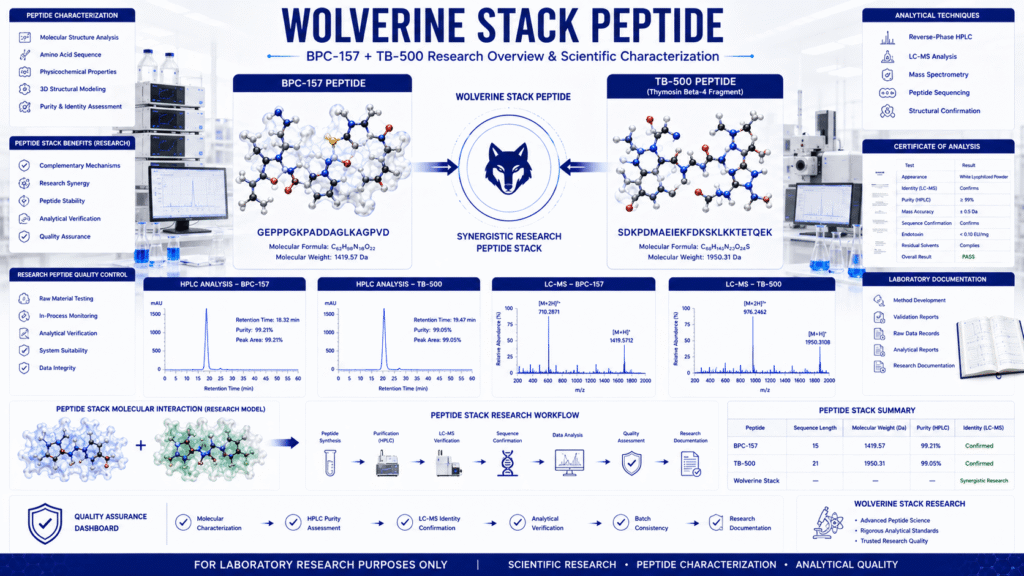
The Wolverine peptide has become a popular topic in peptide research discussions, fitness communities and online wellness conversations. Often referred to as the Wolverine Stack, this combination is commonly associated with two experimental peptides: BPC-157 and TB-500.
Its name comes from the fictional superhero Wolverine, who is famous for his extraordinary ability to recover from injuries. The comparison reflects the way the combination is marketed and discussed online, particularly in relation to tissue repair and recovery. However, the science behind these claims requires a closer look.
So, what exactly is the Wolverine peptide? What are BPC-157 and TB-500, and what does current research actually tell us about their potential applications?
This guide explores the composition, proposed mechanisms, scientific evidence, safety considerations and regulatory status of the Wolverine peptide combination.
What Is the Wolverine Peptide?
The Wolverine peptide, also known as the Wolverine Stack or Wolverine blend, is an informal name commonly used for a combination of two synthetic peptides:
- BPC-157: Body Protection Compound-157, a synthetic peptide consisting of 15 amino acids.
- TB-500: A synthetic peptide fragment associated with thymosin beta-4, a naturally occurring protein involved in cellular processes.
The combination has attracted attention because both compounds have been investigated for biological processes associated with tissue repair and cellular activity.
It is important to understand that Wolverine peptide is not the scientific name of a single compound. It is a marketing term used to describe a combination, and formulations can vary between products.
There is also an important distinction between TB-500 and full-length thymosin beta-4. They are not interchangeable terms, and findings from research involving the full-length protein cannot automatically be applied to TB-500.
What Are the Two Peptides in the Wolverine Stack?
Understanding the individual compounds helps explain why they are frequently discussed together.
1. BPC-157
BPC-157 stands for Body Protection Compound-157. It is a synthetic peptide consisting of 15 amino acids and is based on a sequence associated with proteins found in gastric juice.
BPC-157 has been investigated in preclinical research involving several biological processes, including:
- Cellular signalling and tissue responses.
- Blood vessel formation.
- Tendon and ligament research.
- Gastrointestinal tissue models.
- Muscle and connective tissue research.
Much of the interest in BPC-157 comes from animal and laboratory studies. However, promising preclinical findings do not establish that the compound is effective or safe in humans.
Human evidence remains extremely limited, and larger controlled clinical trials are needed to determine its potential applications.
2. TB-500
TB-500 is commonly described as a synthetic fragment of thymosin beta-4, a naturally occurring protein involved in cellular migration, tissue maintenance and other biological processes.
Thymosin beta-4 has been investigated in different experimental settings, including wound healing and cellular repair.
TB-500 is frequently discussed in connection with:
- Cell migration research.
- Tissue-related biological processes.
- Cellular repair mechanisms.
- Experimental wound-healing research.
- Muscle and connective tissue studies.
One important scientific distinction is that research involving full-length thymosin beta-4 does not necessarily demonstrate the same effects for the shorter TB-500 fragment.
There is currently insufficient human clinical evidence to establish the safety or effectiveness of TB-500 for injury recovery.
How Does the Wolverine Peptide Combination Work?
The Wolverine Stack is discussed because BPC-157 and TB-500 have different proposed biological mechanisms.
BPC-157 has been investigated for its possible involvement in cellular signalling, blood vessel formation and tissue-related responses.
TB-500, meanwhile, is associated with research into thymosin beta-4-related processes, including cell migration and cellular activity.
The theory behind combining the two is that their proposed mechanisms might complement one another.
However, this remains a hypothesis rather than an established scientific finding.
There are no adequate controlled human clinical trials demonstrating that combining BPC-157 and TB-500 produces superior recovery outcomes compared with using either compound individually.
Why Is It Called the Wolverine Peptide?
The name Wolverine peptide is inspired by the Marvel superhero Wolverine, a character known for rapid regeneration and the ability to recover from severe injuries.
The nickname became popular in online peptide communities because the combination is promoted around the concept of tissue recovery.
The name is not a medical classification, pharmaceutical designation or recognised scientific term.
It is also important not to interpret the superhero comparison literally. There is no clinical evidence that the Wolverine Stack can reproduce extraordinary regenerative abilities or guarantee faster recovery from injuries.
What Does Scientific Research Say About Wolverine Peptides?
Research into BPC-157 and TB-500 has generated interest, but the available evidence must be interpreted carefully.
BPC-157 research
Most BPC-157 research has been conducted in laboratory environments and animal models.
Experimental studies have investigated its relationship with tendon, ligament, muscle and gastrointestinal tissue responses.
Although some findings have been encouraging in these models, animal research cannot establish that the same results will occur in humans.
The limited human evidence does not provide sufficient information about long-term safety, effectiveness or appropriate clinical applications.
TB-500 research
Research into thymosin beta-4 has explored its role in cellular migration, wound-related processes and tissue biology.
However, it is essential to distinguish studies involving full-length thymosin beta-4 from studies involving the TB-500 fragment.
Evidence involving one compound cannot automatically be transferred to another simply because they are biologically related.
Research into the combined Wolverine Stack
An especially important limitation is that research on individual ingredients does not establish the effectiveness of the combined formulation.
The Wolverine Stack does not have an established clinical evidence base demonstrating that the two peptides work better together.
| Research area | Current evidence |
|---|---|
| BPC-157 and tissue research | Primarily preclinical |
| TB-500 and cellular processes | Limited experimental evidence |
| Human injury-recovery outcomes | Insufficient evidence |
| Combined Wolverine Stack | No established clinical efficacy |
| Long-term safety | Not established |
| Approved medical treatment protocol | Not established |
The overall conclusion is that the Wolverine peptide remains an experimental combination rather than a clinically validated recovery treatment.

Wolverine Peptide Benefits: What Is Claimed?
Online discussions frequently associate the Wolverine Stack with several potential benefits. These claims generally relate to the biological processes being investigated in laboratory research.
Commonly discussed areas include:
Tendon and ligament research: BPC-157 has been investigated in experimental models involving tendon and ligament tissue.
Muscle recovery research: Both compounds are discussed in relation to cellular processes relevant to muscle and connective tissue biology.
Wound-healing research: Thymosin beta-4 research has explored cellular migration and processes involved in wound repair.
Cellular activity: Both compounds are associated with biological pathways that have attracted interest in tissue-related research.
However, these areas should be understood as research interests, not proven human benefits. There is insufficient clinical evidence to confirm that the Wolverine Stack improves athletic performance, repairs injuries or accelerates recovery in people.
Is the Wolverine Peptide Safe?
Safety is one of the most important considerations when evaluating experimental peptide combinations.
Neither the Wolverine Stack nor its commonly discussed components have an established safety profile for routine human use.
Potential concerns include:
- Unknown long-term effects.
- Immune reactions.
- Peptide-related impurities.
- Contamination during manufacturing.
- Incorrect product identification or concentration.
- Infection and other complications associated with injectable products.
The quality of an unapproved peptide product may also be difficult to verify. A product label alone does not establish its identity, purity, sterility or manufacturing quality.
Anyone with questions about peptide exposure or potential adverse effects should consult a qualified healthcare professional rather than relying on online dosing discussions or anecdotal reports.
Is Wolverine Peptide FDA Approved?
The Wolverine peptide combination is not an FDA-approved treatment.
The FDA has identified concerns relating to compounded BPC-157 and TB-500, including potential immunogenicity, peptide impurities and inadequate human safety information.
Importantly, regulatory developments involving individual bulk ingredients or compounding policies should not be confused with approval of a finished drug product.
Approval requires appropriate evidence of safety and effectiveness for a specific intended use.
Wolverine Peptide in Australia: What Does the TGA Say?
For Australian readers, the Therapeutic Goods Administration (TGA) regulates therapeutic goods, including peptide products.
The TGA has specifically identified BPC-157 and TB-500 among peptide ingredients associated with unapproved products.
Its guidance explains that unapproved peptide products have not been assessed for safety, quality or effectiveness. It also warns about possible problems with product identity, labelling, sterility and contamination.
Australian businesses and consumers should understand that describing a product as being for research purposes does not automatically make its importation, supply or advertising lawful.
The applicable requirements depend on the product and circumstances, and relevant exemptions or authorisations must be considered.
For the latest Australian information, consult the Therapeutic Goods Administration directly.
Wolverine Peptide vs BPC-157: What Is the Difference?
The terms are sometimes used interchangeably online, but they do not mean exactly the same thing.
BPC-157 is an individual synthetic peptide. Wolverine peptide generally refers to a combination of BPC-157 and TB-500.
The distinction is important when researching scientific literature because studies involving BPC-157 alone do not establish the effects of the combined Wolverine Stack.
Similarly, research involving TB-500 or thymosin beta-4 should not automatically be interpreted as evidence for the combined formulation.
Wolverine Peptide vs TB-500: Understanding the Difference
TB-500 is commonly discussed as one of the two components of the Wolverine Stack.
However, TB-500 alone is not the same thing as the complete combination.
The main distinction is composition:
- TB-500 refers to an individual peptide fragment.
- BPC-157 refers to a separate synthetic peptide.
- Wolverine peptide generally describes a combination of the two.
Understanding these differences makes it easier to evaluate research findings and avoid confusing individual compounds with combination products.
Frequently Asked Questions About Wolverine Peptide
1. What is Wolverine peptide made of?
The Wolverine peptide combination is commonly marketed as containing BPC-157 and TB-500. The exact formulation can vary, and the name itself does not guarantee the identity or concentration of the ingredients.
2. Is Wolverine peptide the same as BPC-157?
No. BPC-157 is an individual peptide, whereas Wolverine peptide usually refers to a combination of BPC-157 and TB-500.
3. Is Wolverine peptide the same as TB-500?
No. TB-500 is generally described as one component of the Wolverine Stack. The combination also includes BPC-157.
4. Does Wolverine peptide help with injury recovery?
There is insufficient high-quality human clinical evidence to establish that Wolverine peptide improves injury recovery. Much of the available research involves laboratory experiments and animal models.
5. Has Wolverine peptide been studied in humans?
There is no established controlled clinical evidence demonstrating the safety and effectiveness of the combined Wolverine Stack in humans. Limited human reports involving individual components do not establish the efficacy of the combination.
6. Is Wolverine peptide FDA approved?
No. The Wolverine Stack is not an FDA-approved medicine or treatment.
7. Is Wolverine peptide legal in Australia?
Australian regulations restrict the importation, supply and advertising of unapproved therapeutic goods, subject to applicable authorisations and exemptions. The TGA has specifically raised concerns about products containing BPC-157 and TB-500. Individuals and businesses should check current TGA requirements.
8. What is the difference between Wolverine peptide and the Wolverine Stack?
They are generally two names for the same marketed combination of BPC-157 and TB-500. Neither is a recognised pharmaceutical name.
9. Does combining BPC-157 and TB-500 make them more effective?
There is insufficient clinical research to establish whether combining these compounds produces additional benefits. Claims of synergy remain unproven.
10. Where can I find reliable information about Wolverine peptid?
Reliable information should come from peer-reviewed scientific publications, clinical trial registries and regulatory authorities such as the FDA and Australia’s TGA. Marketing claims and personal testimonials should not be treated as clinical evidence.
