

Peptide
What Is Retatrutide Triple Agonist? Understanding How It Works
Nov
What Is Retatrutide Triple Agonist Understanding How It Works
Most weight-management medicines focus on one or two metabolic pathways. Retatrutide takes a different approach. It has been developed to activate three different hormone receptors involved in appetite regulation, blood sugar control and energy metabolism.
So, what is retatrutide triple agonist, and why has it attracted so much attention in metabolic research?
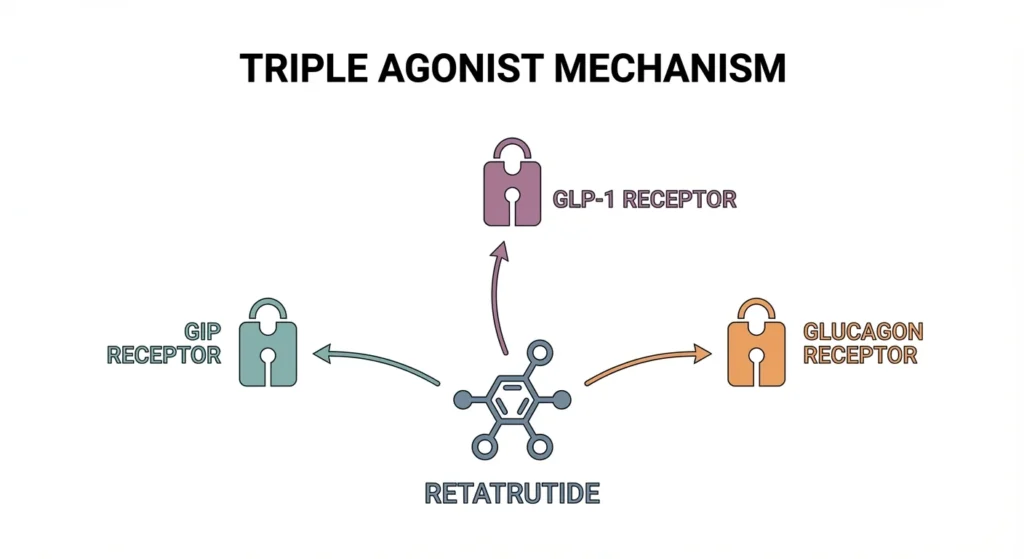
Retatrutide is an investigational peptide designed to activate the GLP-1, GIP and glucagon receptors simultaneously. Researchers are studying how this combination influences body weight, appetite and several other metabolic processes.
What makes it particularly interesting is that each receptor plays a different role in the body. By targeting all three, retatrutide may influence several aspects of metabolism rather than concentrating on a single pathway.
This approach has generated considerable interest in obesity and metabolic research. However, there are still important questions surrounding its long-term effects, safety and potential medical applications.
What Does Triple Agonist Mean?
To understand retatrutide, it helps to start with the word agonist.
An agonist is a substance that binds to a particular receptor and activates it, triggering a biological response. A triple agonist does this across three different receptor systems.
In retatrutide’s case, these are:
- GLP-1: Glucagon-like peptide-1.
- GIP: Glucose-dependent insulinotropic polypeptide.
- Glucagon: A hormone involved in blood glucose regulation and energy metabolism.
Each pathway has its own function, but they also interact with one another. Researchers are interested in whether activating all three can produce a different metabolic response compared with targeting GLP-1 or GIP alone.
This is what separates retatrutide from many earlier compounds being studied for weight management.
It’s sometimes described as a next-generation incretin-based peptide. While that description is useful, it doesn’t explain the entire mechanism. GLP-1 and GIP are incretin hormones, whereas glucagon has a distinct role in regulating energy availability and blood glucose.
The interesting part is how these three pathways may work together.
How Do Retatrutide’s Three Receptors Work?
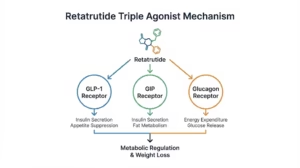
Each receptor contributes something different to the overall mechanism. Understanding their individual functions makes it easier to see why scientists are studying retatrutide as a triple agonist.
1. GLP-1: Appetite Regulation and Blood Sugar Control
GLP-1 is probably the most familiar of the three receptors because it is already an important target in established metabolic medicines.
When the GLP-1 pathway is activated, several things can happen. It can increase feelings of fullness, influence how quickly food leaves the stomach and support insulin release when blood glucose levels are elevated.
These effects explain why GLP-1-based medicines have become an important area of research and treatment for certain metabolic conditions.
Appetite regulation is particularly relevant to weight-management research. Feeling satisfied after smaller meals may reduce overall food intake, although individual responses vary.
However, GLP-1 activity can also produce unwanted gastrointestinal effects. Nausea, vomiting and constipation are among the symptoms reported with medicines that act on this pathway.
2. GIP: Another Important Metabolic Pathway
GIP is another naturally occurring hormone involved in the body’s response to food.
One of its main functions is to support insulin secretion when glucose levels rise. This makes it an important part of the body’s normal blood sugar regulation system.
Its involvement in weight management is more complicated than simply reducing hunger. Researchers are still examining how GIP receptor activation interacts with GLP-1 activity and contributes to overall metabolic changes.
This is particularly interesting in retatrutide because GIP is not working in isolation. Its activity forms part of a broader mechanism involving all three receptors.
Understanding how these signals complement one another could help researchers explain why triple-agonist compounds produce different effects from medicines targeting fewer pathways.
3. Glucagon: Energy Use and Liver Metabolism
Glucagon is slightly different from the other two hormones.
It is best known for helping maintain blood glucose levels, particularly by signalling the liver to release stored glucose when the body needs it.
At first, this might seem unusual in a compound being investigated for weight management. After all, glucagon can increase blood sugar.
However, glucagon signalling is also involved in energy expenditure and fat metabolism. Researchers are therefore interested in whether activating this pathway alongside GLP-1 and GIP could produce additional metabolic effects.
This is one of the most distinctive features of retatrutide.
Rather than focusing exclusively on appetite and glucose-dependent insulin signalling, its design incorporates a third pathway associated with energy regulation.
The balance between these receptor activities is important, and scientists are continuing to investigate how they influence both effectiveness and tolerability.
Why Has Retatrutide Attracted So Much Research Interest?
Body weight is influenced by more than hunger alone.
Hormonal signals, energy expenditure, insulin activity, digestion and the body’s response to food all contribute to metabolic regulation. This makes obesity a complex condition that cannot always be addressed through a single biological pathway.
Retatrutide has attracted attention because it is designed to influence several of these processes simultaneously.
Clinical studies have reported substantial reductions in body weight among participants over specific study periods. Researchers have also observed changes in certain metabolic measures.
These findings have made retatrutide an important subject in ongoing obesity research.
However, clinical trial results need to be interpreted carefully. Participants are selected according to specific eligibility requirements and monitored throughout the study. Their results cannot automatically predict what will happen in other individuals.
There is also a difference between promising clinical findings and an established medical treatment. Further research is needed to understand long-term outcomes, potential risks and the populations most likely to benefit.
What Is Retatrutide Triple Agonist Research Trying to Establish?
The research surrounding retatrutide goes beyond whether it can reduce body weight.
Scientists are also examining how its effects develop over time, how it compares with existing metabolic treatments and what happens when treatment is discontinued.
Some of the important research areas include:
- Blood glucose regulation: Understanding how the three receptor pathways influence glucose levels and insulin activity.
- Energy expenditure: Investigating the contribution of glucagon receptor activation to metabolic activity.
- Body composition: Examining changes in fat mass and lean body mass during treatment.
- Cardiovascular health: Assessing changes in relevant cardiovascular measures and longer-term outcomes.
- Gastrointestinal effects: Understanding how common digestive symptoms develop and whether they can be managed.
- Long-term weight management: Investigating whether weight changes can be maintained after treatment ends.
These questions matter because a treatment’s potential cannot be judged by weight reduction alone.
For example, researchers also need to understand how changes in body composition affect overall health. Losing weight and maintaining healthy muscle mass are not necessarily the same thing.
Long-term studies are therefore essential for developing a clearer picture of retatrutide’s potential role in metabolic medicine.
Retatrutide Safety and Regulatory Status in the UK
Although retatrutide has generated considerable interest, it is important to distinguish investigational research from approved medical treatment.
Retatrutide is not an authorised weight-management medicine in the UK. It should not be treated as an approved prescription alternative simply because it is discussed alongside established GLP-1 medications or advertised online.
Clinical research has reported gastrointestinal side effects, including:
- Nausea.
- Vomiting.
- Diarrhoea.
- Constipation.
- Other digestive discomfort.
Some participants have also experienced changes in heart rate and other metabolic measurements that require continued investigation.
The frequency and severity of side effects can vary, and research findings do not establish that the compound is safe for unsupervised use.
Anyone interested in weight-management treatment should discuss their options with a qualified healthcare professional. This is particularly important for people with existing medical conditions, those taking other medications, and anyone who is pregnant, breastfeeding or planning pregnancy.
Online product descriptions and anecdotal experiences are not substitutes for proper medical advice.
Understanding Research-Designated Retatrutide Products
Retatrutide is also frequently discussed on websites specialising in research-designated peptides.
When reviewing information about these products, it is important to understand that packaging, presentation and advertised purity claims do not establish pharmaceutical quality or suitability for human use.
One document often mentioned in the peptide market is the Certificate of Analysis (COA).
A COA provides analytical information about a particular batch and can help establish what testing has reportedly been carried out. Ideally, it should identify the batch, testing methods and results, with laboratory details that can be independently verified.
However, a COA does not establish that a product is sterile, approved as a medicine or safe for injection.
This distinction is important because laboratory documentation and regulatory approval serve different purposes.
Storage and handling information also matter when evaluating specialist research materials. Different compounds can have different stability requirements, so assumptions based on another peptide’s instructions should be avoided.
Clear product descriptions, verifiable documentation and realistic claims provide a better basis for evaluating information than promotional language alone.
How Is Retatrutide Different From Other GLP-1-Based Approaches?
One reason people search for retatrutide is to understand how it differs from more familiar metabolic medicines.
The main distinction is the number of receptor pathways involved.
Traditional GLP-1-based approaches primarily target the GLP-1 receptor. Dual-agonist approaches involve two pathways, while retatrutide has been designed to activate three: GLP-1, GIP and glucagon.
This difference makes its mechanism particularly interesting to researchers.
However, targeting more receptors does not automatically mean a compound is better, safer or more suitable for everyone. Effectiveness depends on several factors, including the specific biological response, tolerability and long-term safety.
Comparisons should therefore consider clinical evidence rather than relying solely on the number of receptors involved.
Final Thoughts: Understanding Retatrutide’s Triple-Agonist Mechanism
Retatrutide is an interesting development in metabolic research because it takes a broader approach to receptor activation.
By targeting GLP-1, GIP and glucagon receptors, it is designed to influence appetite regulation, glucose-dependent insulin signalling and energy metabolism through three interconnected pathways.
That combination helps explain why researchers are paying close attention to it.
However, there is still much to learn about its long-term effects, safety profile and potential place in medical treatment. Promising clinical findings should be recognised, but they should not be confused with established medical approval.
Ultimately, understanding what retatrutide triple agonist means requires looking beyond the term itself. Its significance lies in how the three receptor pathways interact, what clinical research has demonstrated so far and which important questions remain unanswered.
