

Peptide
Retatrutide Pen vs Vial: Understanding the Differences
Nov
Retatrutide Pen vs Vial: Understanding the Differences
When comparing a retatrutide pen vs vial, the decision involves more than just the way each product looks. Product format can influence storage requirements, handling, packaging, preparation and the information buyers need to check before considering a product for legitimate research purposes.
Pens are often presented as a more convenient, self-contained option, while vials have a different format commonly associated with laboratory research. Although both are frequently discussed in the peptide market, neither format automatically guarantees better quality or greater reliability.
Retatrutide itself is an investigational triple agonist designed to act on GLP-1, GIP and glucagon receptors. It has attracted considerable interest in metabolic research, particularly because of its potential effects on appetite and body-weight regulation.
However, it is important to understand that retatrutide is not an authorised weight-management medicine in the UK. Online product descriptions should not be treated as evidence of medical approval or suitability for human use.
Retatrutide Pen vs Vial: What Is the Difference?
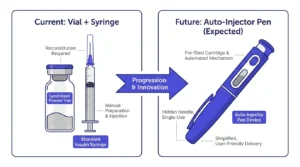
The most obvious difference between these two formats is how they are presented and packaged.
A retatrutide pen is generally marketed as a self-contained delivery device. Depending on the particular product, it may contain a prefilled formulation within the device itself. This makes the format relatively straightforward to identify and organise.
A vial, on the other hand, is a small sealed container that may contain a liquid or freeze-dried material. The exact contents and intended handling requirements should be clearly identified in the accompanying documentation.
It is worth remembering that appearance alone tells you very little about product quality. A professionally packaged pen does not automatically contain a verified formulation, just as a properly labelled vial does not establish purity or sterility.
The more meaningful comparison involves the stated product specifications, batch identification, storage information and supporting quality documentation.
Why Are Retatrutide Pens Popular?
One reason pens attract attention is their relatively straightforward presentation.
A self-contained device can reduce the number of separate components involved in handling and storage. For organisations managing research materials, this type of packaging may also make product identification and inventory organisation easier.
Another advantage is that the format can be easier to distinguish from other laboratory materials. Clear labelling and product identification can help reduce confusion when multiple research compounds are being stored.
However, convenience should never be confused with quality assurance.
Different products may have different specifications, concentrations, storage requirements and expiry information. These details should always be verified rather than assumed from the appearance of the device.
Price is another consideration. Pens may carry a higher advertised price because of their packaging and presentation. Whether that difference represents meaningful value depends on the actual product specifications and supporting evidence.
Why Are Vials Still Common in Peptide Research?
Vials have long been used in laboratory and pharmaceutical settings because they provide a compact way to contain and identify different materials.
Depending on the product, a vial may contain a prepared liquid or a freeze-dried substance. These are not interchangeable formats, and the distinction should be clearly explained in the relevant product documentation.
For legitimate laboratory research, vials can form part of established material-handling and inventory procedures.
However, they also require careful attention to storage, labelling and handling. A damaged seal, unclear product identification or unsuitable storage conditions can raise questions about the integrity of the material.
This is why a low advertised price should not be the main reason for choosing a vial.
Before making comparisons, it is important to understand exactly what the listing describes and whether the supporting documentation matches the product being advertised.
Retatrutide Pen vs Vial: Comparing Price and Value
Price is often one of the first things people compare when researching different retatrutide formats.
However, looking at the headline price alone can be misleading. Two products may have completely different specifications, quantities or packaging arrangements.
A more meaningful comparison starts with the information provided by the supplier.
Consider these factors:
- Product specifications: Check whether the stated contents and product identity are clearly explained.
- Batch information: Look for a batch or lot number that can be matched to the accompanying documentation.
- Quality testing: Check whether relevant analytical information is available and independently verifiable.
- Storage requirements: Review the stated conditions and whether the supplier explains how the material should be protected.
- Packaging: Consider whether the packaging is intact, properly identified and appropriate for the stated product.
- Supplier transparency: Look for clear business information and accessible customer support.
A cheaper listing is not necessarily better value if important details are missing. Equally, a premium price does not establish that a product has undergone better testing.
The most useful approach is to distinguish between what a seller claims and what can actually be verified.
Why Batch Documentation Matters for Both Formats
Whether a product is advertised as a pen or vial, batch documentation remains an important part of assessing supplier claims.
One commonly referenced document is the Certificate of Analysis (COA). It provides analytical information relating to a particular batch and may include details about the testing methods and reported results.
A useful COA should contain identifiable batch information that corresponds with the product being described. Laboratory details and testing information should also be available for verification.
However, there are important limitations.
A Certificate of Analysis does not automatically establish sterility, pharmaceutical manufacturing standards, regulatory approval or suitability for human use.
These distinctions are particularly important in the peptide market, where quality-related terminology is sometimes used without enough supporting evidence.
Clear documentation is valuable, but it should always be interpreted within its proper context.
Storage and Product Handling: What Should You Know?
Storage is another important difference to consider when discussing retatrutide pen vs vial formats.
Different formulations can have different stability requirements. Temperature, light exposure and handling conditions may all influence product integrity.
A pen may appear easier to organise because it is contained within a single device. However, its packaging does not eliminate the need to follow the specific storage conditions stated by the manufacturer.
Vials also require appropriate storage and careful identification. Their smaller size makes proper organisation particularly important when multiple materials are present.
For both formats, general assumptions are not enough. Storage requirements should come from reliable, product-specific documentation.
If the product’s identity, seal or storage history is uncertain, its condition should not be assumed to be acceptable.
It is also important not to rely on generic online demonstrations or advice about preparing injectable materials. Research-designated products should not be used for self-administration, and appropriate professional oversight is essential for any medical decision.
Which Retatrutide Format Is Better?
There isn’t a straightforward answer because the format alone does not determine product quality, effectiveness or safety.
Pens are generally associated with a more self-contained presentation, while vials offer a different type of packaging commonly encountered in laboratory research.
However, neither should be considered superior simply because of its appearance or advertised convenience.
For legitimate research purposes, the more important questions concern product identity, documentation, storage conditions and whether the material meets the requirements of the relevant research setting.
Anyone considering retatrutide for personal weight management should speak with a qualified healthcare professional. Since retatrutide remains investigational and is not an authorised UK weight-management medicine, online product listings should not be used as a basis for treatment decisions.
